Are you keeping pace with rapid changes in the built environment?

Meeting of like minds –

The NFMT 2019 conference in Baltimore has just wound up. For those of you not lucky enough to attend or just too swept up in the event to digest the wealth of industry insights available to delegates, take 20 mins on your way home today to listen to this from two FM leaders.

Stormy and Stan have been long-time pioneers in FM standardisation, collaboration, and communication, and they believe that customer service is key when creating an environment where people can thrive. Stormy Friday is President of The Friday Group, an internationally recognised woman-owned facilities management consulting firm that generates customised solutions and strategies for current business issues and challenges.

Hear digital workspace expert, Mike Petrusky as he chats to Stormy and Stan on how FM professionals can keep pace with the fast-changing world of the built environment where technology is having such a significant impact. They agree that we must all commit to being lifelong learners and continuing education at events like the NFMT 2019 Conference are essential. Stan and Stormy both played a role on the commission that helped to develop the ProFM, a training and credentialing program built to celebrate the diversity and growth in facilities management. With a focus on asset, risk, business management, and operations and maintenance, ProFM is designed to prepare FMs for the future workplace.
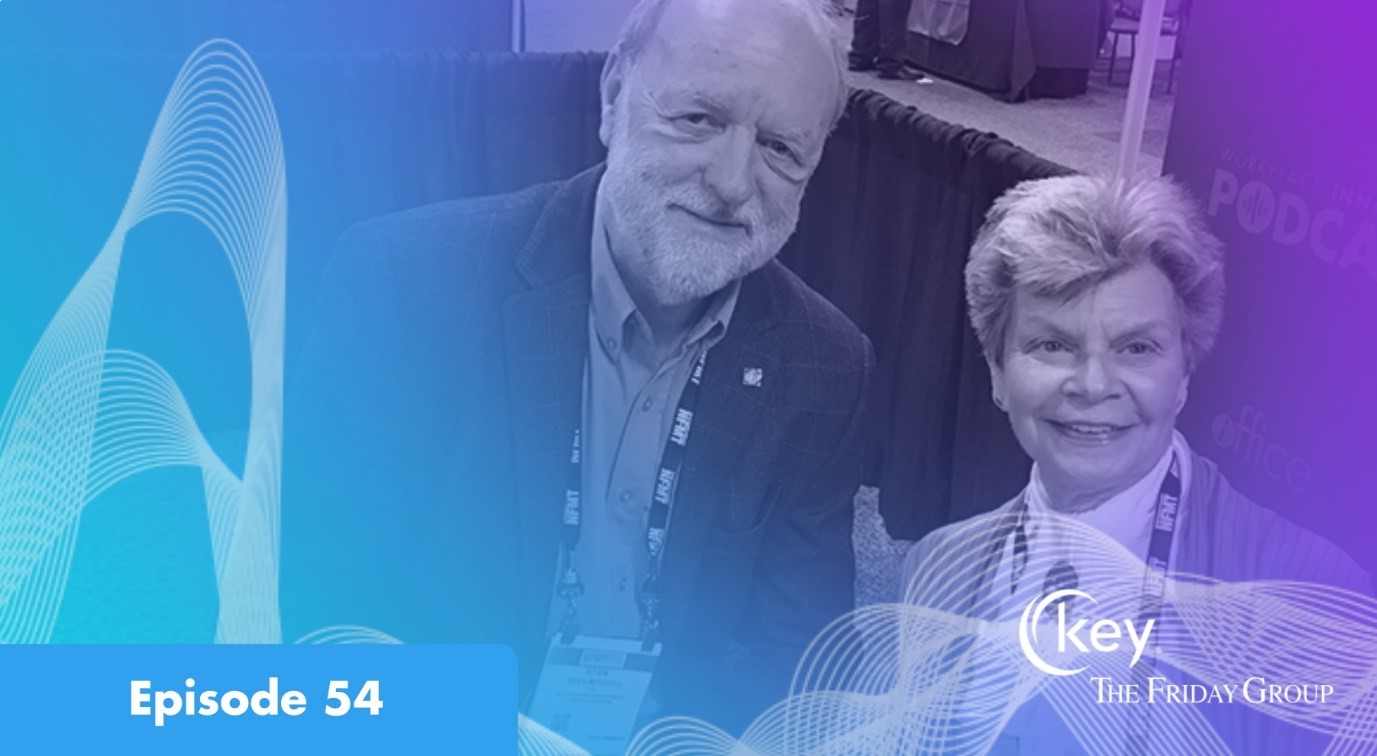
Stan and Stormy

FM Customer Service and The ProFM Credential Program, Source: iOFFICECORP.com

Want to hear more? Connect today with Stan and KeyFM on LinkedIn.


Risk Aversion: Barrier to and Driver of Smart FM

This article argues that the inherent risk aversion of the Facilities Management (FM) profession, which to-date has been a barrier to the adoption of smart FM technologies, in 2017-18 is becoming one driver of a sea change.

The Smart Revolution: so what’s the holdup?

Consensus is building that we’ve reached the tipping point in the use of the Internet of Things (IoT).

The basic conditions necessary for a smart technology revolution have been in place for several years.

On the side of the technologists, increasing competition and investment have fuelled rapid evolution in the affordability, usability and connectivity of sensors and platforms.

On the client side, there has been a corresponding growth in awareness of the promise of smart operations to deliver those efficiencies and marginal gains upon which c21st success depends.

The holdup has been the lack of a party with sufficient understanding of the technology, and the clients’ needs and operations, to weave solutions that deliver on this promise.

Inherent Risk Aversion as a Barrier to Smart FM

Clearly, FM is best equipped and placed to fulfil this role.  There is also increasing pressure for us to do so.  IoT is quickly becoming a client expectation both within existing contracts and the tendering process.

Nevertheless, FM is an inherently conservative profession, underpinned by the principle that ‘if it ain’t broke, don’t fix it’.  This is particular so in challenging economic times such as these.

While technology has become central to our toolkit, FM is often a hidden laggardly influence in the adoption curve.  Many providers are driven reluctantly by client demand, not by intrinsic innovation.

In the case of IoT, this resistance is exacerbated by implications more radical and haunting than previous technologies.

There are concerns around ownership, security and unproven technology.  Deeper still, there are existential questions around FM’s role and purpose in a world where buildings effectively manage themselves.

The explicit and implicit threats are non-trivial, not least wholesale restructuring, downsizing, and loss of control and expertise.

Facilities Managers 'Minding the Gap' between smart technology providers and the market.

Are Facilities Managers ‘minding the gap’ between smart FM technology and the client?

On these bases, we attribute the failure of smart FM to go mainstream already, in part, to the risk aversive nature of FM.

Risk Aversion as a Basic Principle of FM

Nevertheless, in the arena of operations, risk aversion is one of FM’s basic principles.  We assess and mitigate risk, and implement processes to ensure that failure events have minimum impact on business continuity.

It is in the area of risk management that IoT aligns best with the conservative FM mind-set.

Smart sensors offer an affordable, quickly implemented solution for remotely monitoring critical assets and environments.  This application enables Facilities Managers without threatening to change them.  It also allows them to take a low-risk first step into the world of IoT, and to learn about the technology and its win-win benefits for FM and clients.

Once that step’s taken, there’s no turning back!

Risk Aversion as a Driver of Smart FM

Unsurprisingly, therefore, risk management is one area where we are seeing an acceleration in the adoption of smart FM technologies.  This is particularly apparent in the food and manufacturing sectors, and also as a mechanism to plug risky gaps in business information systems.

There is also a growing trend for looking beyond the measurement of discrete variables such as temperature, humidity and vibration. The new frontier is to understand the complex behaviour of specific assets and environments. The goal is to predict and resolve business critical issues before they occur.

The major advances to-date are in farming, for example, to monitor disease in cattle, the quality of the shellfish marine environment, and the interior conditions of beehives.  Smart sensors are also being developed which can pre-empt breakdown of cars and and even the human body!!

It is inevitable that similar context-specific condition-based monitoring will become integral to planned preventative maintenance and FM.  It is proposed one catalyst for this transformation is and shall be the management of business continuity risk.

Conclusion

This article has argued that, paradoxically, FM’s inherent risk aversion is both a barrier to and underlying driver of the mainstream adoption of smart technologies.  A catalyst for the shift from the former to the latter is proposed to be FM’s recognition of the value of IoT for ensuring business continuity.

Check out KEY’s case studies on our application of smart technologies for the management of business critical assets and environments.

Listen to a podcast on the future of smart technologies for risk management and FM from Gordon Mitchell, KEY’s Chief Information Officer.

For more KEY views, updates and insights follow us on Facebook, Twitter and LinkedIn.

The first International Facility Management Standards: An Overview

2017-18 will go down as historic years for the global Facility Management (FM) sector!

Things kicked off on Friday 31st March ’17 when the ISO 267 Facility Management committee published its first two international facility management standards.  A third followed on July 12th.

These first three standards are:

  • ISO 41011 standardises an international vocabulary for FM.  The standard affords a clear common terminology for providers and customers.
  • ISO 41012 gives guidance on strategic sourcing and the development of agreements.  The standard helps define and regulate a better working relationship between providers and customers.
  • ISO 41013 outlines the scope, key concepts and benefits of FM, while also providing a context for the use and application of the terms already defined in ISO 41011.


Announcing the publications, Stan Mitchell, our CEO and acting Chair of the ISO 267 FM Technical Committee, said:

“Many thanks indeed to the forty two countries who have supported the committee.  Special thanks to Paul Stadlöder, Jay Drew and Olav Egil Sæbøe for their leadership who along with the hard working members of their respective committees have delivered. Well done to all and many thanks on behalf of Facilities Managers everywhere for getting us on the map!  There is more to come, make sure that your country is represented so that you can participate”

Well done too to Stan, who has been integral in the process leading to these groundbreaking publications, and those to come.  He inspired international support for the ISO FM Technical Committee, which he leads in the creation of these new FM standards.


Management Systems Standard ISO 41001: The real game changer!

Particularly, many are on tenterhooks regarding the upcoming ISO 41001, due for publication in Spring 2018.  ISO 41001 deals with the requirements and guidance for use of management systems.  It aims to improve awareness and support for effective facilities management regimes globally and across all sectors.

ISO 41001 will help facilitate appropriate FM structures and resourcing.  The standard is set to transform business management globally, providing markets with a model for developing a world class FM regime.  Additionally, it will provide a basis for professional training and certification, and supplier benchmarking for public and private sectors.

We’ll be posting on the themes of the new standards for the rest of August, with regular updates beyond.  (Next Friday: a video of a presentation by our CEO on their development and implications of ISO 41001!).

Want to know more about the standards, or keep abreast of their progress?  Then we welcome you to follow us on Facebook, Twitter or LinkedIn.

Equally, if you need support with ISO 41001 accreditation and your operational efficiency from those who led development of the new standards, do get in touch.

Bringing the Benefits of True FM to the Highland and Islands Region

One of KEY’s 2017 objectives is the significantly expansion of our operations in the Highlands and Islands region.  Our aim is to bring the benefits of our home-grown True FM to local businesses and organisations.

“We’re the longest running FM company in the UK.  While we have a global arena of operations, bringing value to our Scottish homeland has always been of special importance to us,” KEY CEO, Stan Mitchell.

KEY’s flagship project in HIE is ‘Nucleus’, which opened February 2017.  Nucleus is a new 5,000 square metre archiving facility in Wick.  We supported Crimson UK Ltd and Restore Scan Ltd throughout the design and mobilisation process.  Now we provide ongoing services for them including M&E maintenance, energy management, cleaning and other FM aspects.

“KEY supported us through all the various phases of the archive project from tender through mobilisation and into operational. They have provided a professional and innovative service which enabled us to better support our own client.  We have built an excellent ‘one team’ working relationship over the last two years.  We look forward to this continuing for many years to come,” Edd Whiting, Contracts & Commercial Manager, Restore Scan Ltd.

A core responsibility for us at Nucleus is to maintain strict environmental conditions.  This is required to protect historic records for the UK nuclear industry, and also for Caithness County.  Some of the latter date back to the c16th century.

Says Stewart Lackie, a senior Key consultant, “Wick is a perfect example of Key’s True FM thinking and value in action.  We intend to repeat that success for other organisations across the Highlands and Islands in 2017 and beyond.”

True FM is KEY’s core differentiator: a broader aspirational vision of operations which interweaves people, place, proven method and smart technologiesTrue FM revolves around the principle of optimal performance for each and every customer. It is underpinned by our unique capacity to understand your operations, needs and budget constraints.  In turn, this capacity enables us to tailor the right solution for you. Says Stewart:

“The era of the one size fits all approach to FM is over.  Relentless economic and regulatory pressures necessitate nuanced solutions tailored to the specific needs of each enterprise.  For these to deliver optimal value in each case, they need to leverage the best of what’s possible today, and be able to adapt and improve to changing circumstances,” Stewart Lackie, senior KEY consultant.

KEY’s Facilities Management Solutions embody the concept of a integrated, futureproof and cost-effective systems. Alongside conventional FM, these solutions can include maintenance management, smart sensor monitoring, and workplace optimisation.  All our designed for control, and easy implementation and scalability.

If you’re located in the Highlands and Islands region, and think you might benefit from help from the True FM experts, then talk to at sharedservices@key.fm or +44 (0) 1786 841603.

Key CEO receives BSI Leadership Award for contribution to global Facilities Management

We are proud to announce that our CEO, Stan Mitchell, has received a prestigious BSI Leadership Award from the British Standards Institution (BSI).  The accolade was for “strong and visionary” leadership, and Stan’s  outstanding contribution to raising the status and standards of the global facilities management (FM) discipline.

The BSI cited Stan’s “enthusiasm, superb industry reputation and support for new members”.  This was seen as important in maintaining membership and momentum Chair of the FM Technical Committee.  He has held this position for the 13 years since its inauguration.

Of his achievements, the BSI drew special attention to how Stan personally galvanised international support for a new ISO FM committee.  He subsequently also led its creation and the initiation of the new ISO FM Management System Standard, ISO 41001.

Also commended was Stan’s leadership as acting chair of a UK panel which supports ISO experts.  In this role, he was said to have demonstrated “diplomacy and excellent communication skills which have helped resolve a number of fundamental disagreements through consensus”.

Congratulations Stan! Below is a photo of the BSI award taking pride of place on the wall at our Head Office.